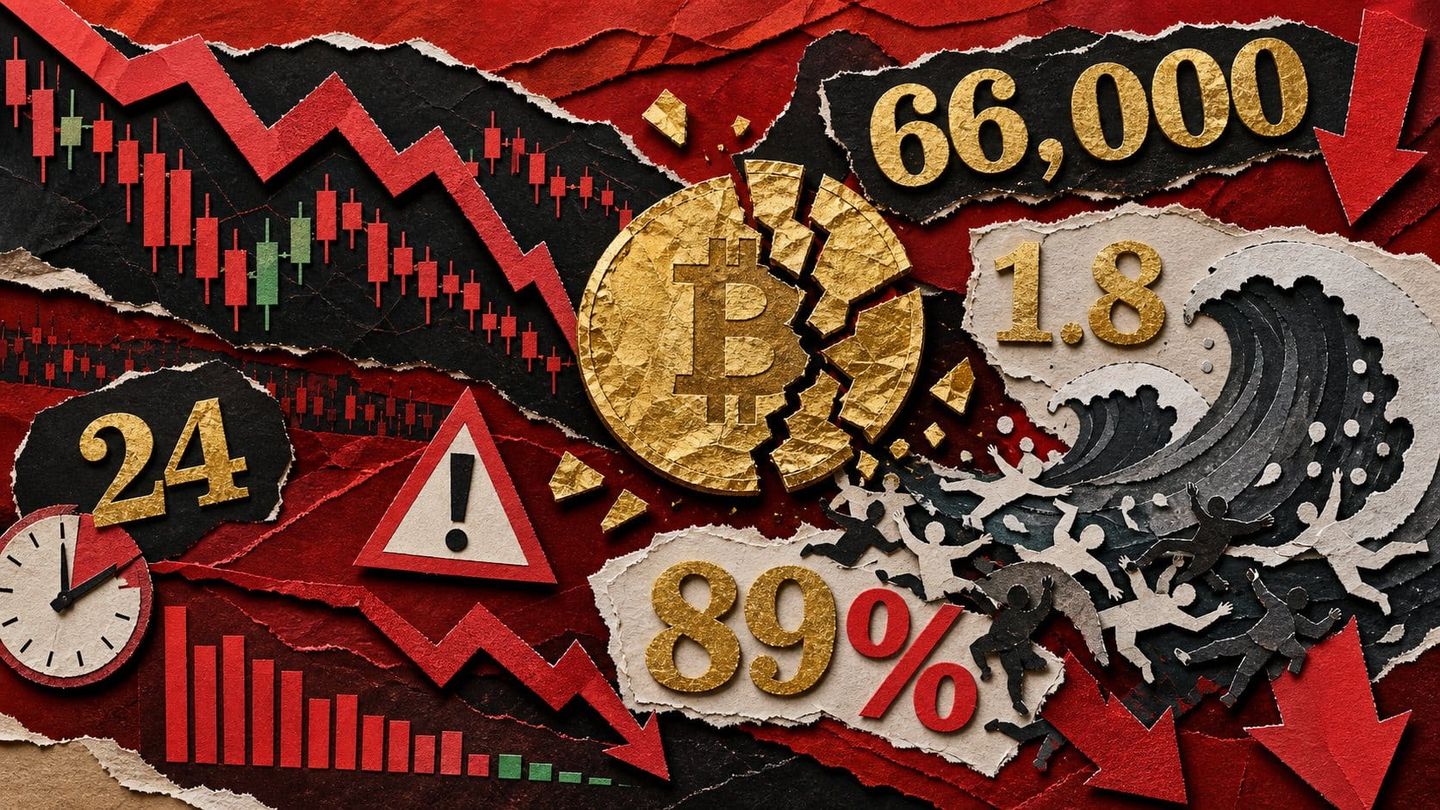
Crypto's leverage stack snapped on Wednesday. A single 24-hour window erased $1.84 billion in bullish bets, and nearly nine in ten of those were longs caught on the wrong side of a fast move.
What Happened: $1.84B Forced Out in 24 Hours
Bitcoin dropped roughly 8% from Tuesday's high near $71,300 to a nine-week low around $65,360 by early Wednesday, June 3, 2026 — its lowest level since March 29 . The break below $66,000 triggered about $1.84 billion in leveraged liquidations in 24 hours, the largest single-day forced-closure event since February 2026, per CoinGlass data reported by CoinDesk .
Quick Answer: On June 3, 2026, Bitcoin fell ~8% to a nine-week low near $65,360, breaking $66,000 and forcing about $1.84 billion in leveraged positions to close in 24 hours. Roughly 88–90% were long bets — a one-sided deleveraging flush, not a balanced sell-off.
This was overwhelmingly a long-side washout. Between 88% and 90%-plus of the liquidations came from bullish positions, meaning traders had crowded into leveraged upside and got flushed as support failed . Ethereum slid under $1,900, and total crypto market capitalization was pushed back toward $2.3 trillion after rejecting near $2.7 trillion .
| Long liquidations by asset (24h) | Amount |
|---|---|
| BTC longs | ~$884M |
| ETH longs | ~$476M |
| SOL longs | ~$91M |
| Largest single unwind (BTC-USDT long, HTX) | $59.67M |
The figures above come from CoinDesk's CoinGlass snapshot . Venue concentration tells the rest of the story: Binance alone handled about $748 million — roughly 41% of the entire cascade . Note that totals drift by source and rolling window; other dashboards logged $1.83B to $1.86B, so treat every number here as approximate .
Three Converging Causes — Not One Headline
The $1.8 billion flush had three drivers stacked on top of each other, not a single war headline. Geopolitics lit the fuse, but crowded long leverage and a 12-session run of ETF redemptions had already built the powder keg. Treat the U.S.-Iran escalation as the amplifier — not the sole cause.
The military backdrop was real and documented. U.S. Central Command said it defended against Iranian ballistic missiles and drones and struck a ground-control station on Qeshm Island on June 2, 2026 . Missiles fired toward Kuwait fell short and three aimed at Bahrain were intercepted . With the Strait of Hormuz in play, Brent crude rose to around $97.60 . Bitcoin traded as a high-beta risk asset, not a safe haven.
The second pressure point was institutional selling. U.S. spot Bitcoin ETFs posted $519.19 million in net outflows on June 2 — a 12-session streak, the longest since the funds launched in January 2024 . BlackRock's IBIT alone shed $388.64 million, and two-day damage reached roughly $1 billion . The regulated buyer of the last cycle had turned seller.
The third cause was positioning that was lopsided before any headline hit. Long-short ratios going into the flush:
- Binance: 2.22 long-short ratio
- OKX: 2.01
- Bybit: 1.58
The crowd was overwhelmingly long, so a downside move forced cascading liquidations rather than a balanced two-way shakeout. That mechanic explains why 88%–90%+ of the wipeout hit bullish bets.
Not every analyst blames the strikes. "The drop is driven more by leveraged liquidations, heavy ETF outflows, and technical breakdowns than pure Iran news, but it amplifies the fear," Andri Fauzan Adziima, Research Lead at Bitrue Research Institute, told Cointelegraph . In other words: geopolitics pulled the trigger, but the market loaded the gun.
What to Watch: $60K or a Bounce?
The immediate question is whether the $64,000–$65,000 zone holds. That band marks Bitcoin's nine-week low near $65,360 set early on June 3, and traders are watching it as the first floor before deeper support at $60,000–$61,000. A clean break below would put the round-number $60,000 level in play as the next major test.
Analysts are split on which way it resolves. Trader Michael van de Poppe flagged the $60K–$66K band as a crucial accumulation zone where spot demand would likely step in.
"$65,000–$66,000 is reasonable support for a short-term bounce, but a $60K retest is possible," — analyst Colin Talks Crypto (source: Cryptonews).
Positioning data sends a mixed signal. This was a deleveraging flush, not a full capitulation:
- OKX whale long-short ratio collapsed to 0.54, an extremely bearish reading from large accounts.
- BTC open interest actually rose from about 759,000 to 788,600 contracts — fresh positioning entering the volatility rather than wholesale exit.
- Retail stayed net-long, with Binance's long-short ratio at 2.22 even after the wipeout.
The cleanest signal to track is institutional flow. U.S. spot Bitcoin ETFs have now logged 12 straight sessions of net outflows — the longest streak since the funds launched in January 2024 — with $519.19 million leaving on June 2 alone. The regulated marginal buyer of this cycle has temporarily turned seller.
The takeaway: watch for the first day daily ETF flows flip net positive. Until they do, $60,000–$61,000 stays the line that decides whether this was a leverage reset or the start of a deeper trend break.
Frequently asked questions
Why did Bitcoin crash below $66,000 on June 3, 2026?
Bitcoin fell below $66,000 because three pressures converged, not because of one headline. A renewed U.S.-Iran military flare-up near the Strait of Hormuz triggered a broad risk-off move, while U.S. spot Bitcoin ETFs extended a 12-session outflow streak with about $519 million leaving on June 2 alone. Crowded long leverage then cascaded into roughly $1.84 billion in forced liquidations. The geopolitical shock amplified an already fragile, over-leveraged setup rather than acting as the sole cause.
How big were the crypto liquidations and which assets were hit hardest?
About $1.84 billion in leveraged positions were forcibly closed within 24 hours — the largest single-day liquidation event since February 2026. The damage was overwhelmingly long-side, with 88%–90% of liquidations from bullish bets. By asset, CoinDesk reported BTC longs near $883.66 million, ETH longs $475.73 million and SOL longs $91.18 million. DOGE, SUI, HYPE, BNB, NEAR, AAVE and LINK were also caught in the cascade.
Is Bitcoin's $65,000 level strong support or will it fall to $60,000?
Analysts are split, and the level is contested rather than confirmed. Several traders cite the $64,000–$66,000 band as a reasonable near-term bounce zone, while flagging $60,000–$61,000 as the next significant support if selling pressure from ETF redemptions and fresh shorts persists. Open-interest contract counts actually rose from about 759,000 to 788,600, suggesting fresh positioning into the volatility rather than full capitulation.
Were Bitcoin ETF outflows a major factor in the crash?
Yes — institutional selling was a clear pressure point. U.S. spot Bitcoin ETFs posted $519.19 million in net outflows on June 2, extending the redemption run to 12 trading sessions, the longest since the funds launched in January 2024. BlackRock's IBIT alone redeemed $388.64 million, and combined with Monday's outflows the two-day total reached roughly $1 billion. The marginal regulated buyer of this cycle had temporarily turned net seller.
How did U.S.-Iran military strikes affect crypto markets?
The strikes pushed Bitcoin to trade as a high-beta risk asset, not a safe haven. U.S. Central Command confirmed self-defense strikes on a ground-control station on Qeshm Island on June 2, with Iranian missiles intercepted over Kuwait and Bahrain and no U.S. personnel harmed [strike report]. With the Strait of Hormuz being the world's largest oil-transit chokepoint, Brent crude rose to around $97.60 , and Bitcoin sold off alongside global equities.