Bitcoin Breaks $70K While McHenry Signals Fast-Track Legislation and BofA Warns of $6T Stablecoin Shift—The Perfect Storm of Three Converging Crypto Signals
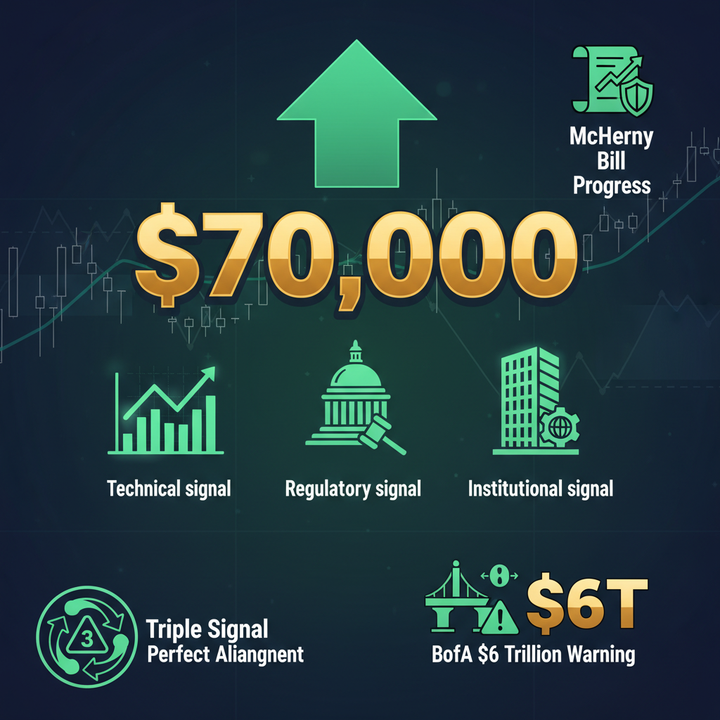
Bitcoin just reclaimed $70,000. Simultaneously, Rep. McHenry announced crypto legislation is 'accelerating.' Bank of America warned $6 trillion in deposits could flow to stablecoins. Three signals rarely align this perfectly—and when they do, markets restructure. Here's what's actually happening.
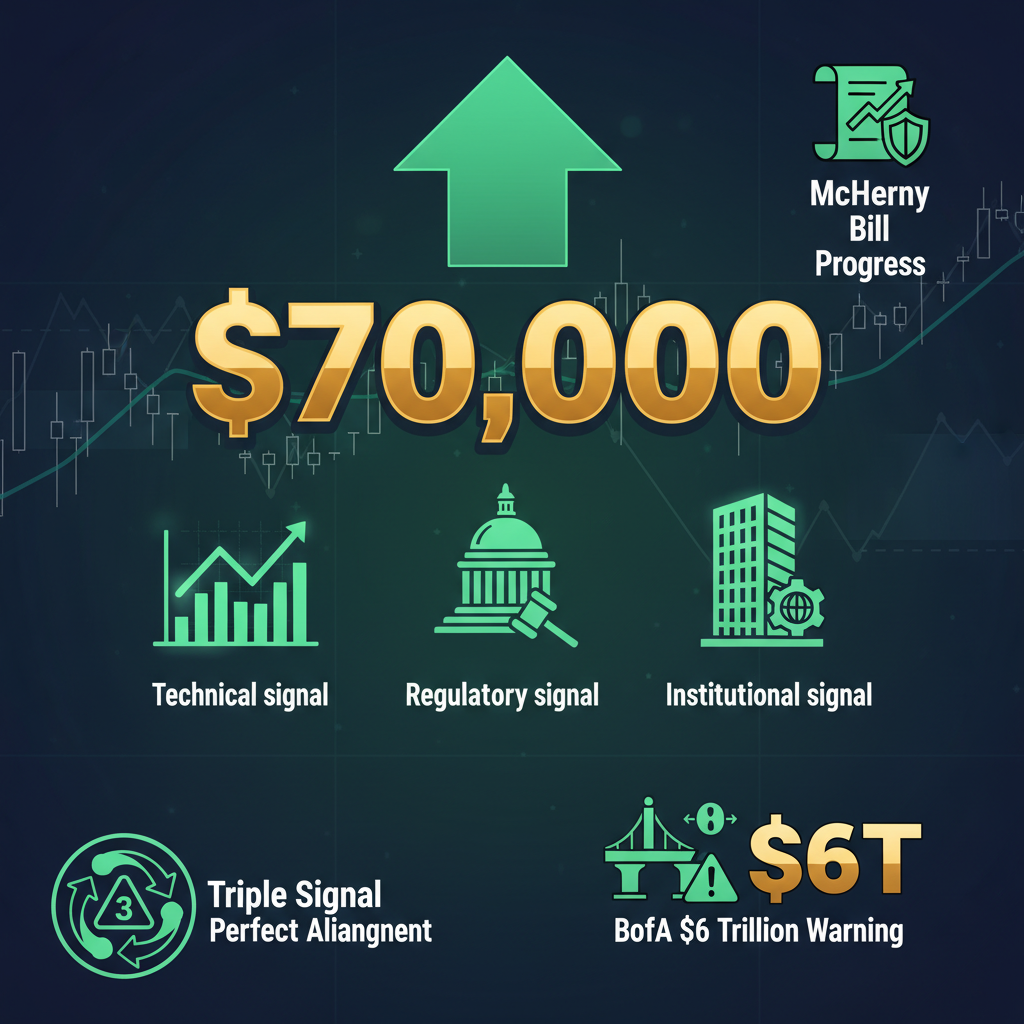
Bitcoin just reclaimed $70,000. In the same 24-hour window, Rep. Patrick McHenry announced that crypto legislation is 'accelerating.' And Bank of America's CEO warned that $6 trillion in deposits could migrate to stablecoins.
Three signals. Same timing. One narrative: crypto is no longer peripheral.
This convergence hasn't happened cleanly since 2020. When it does, markets reorganize. Here's what the data actually tells us—and what investors need to understand before these three signals either reinforce or contradict each other.
Signal 1: Bitcoin $70,000 Isn't Just a Price Level—It's a Pivot Point
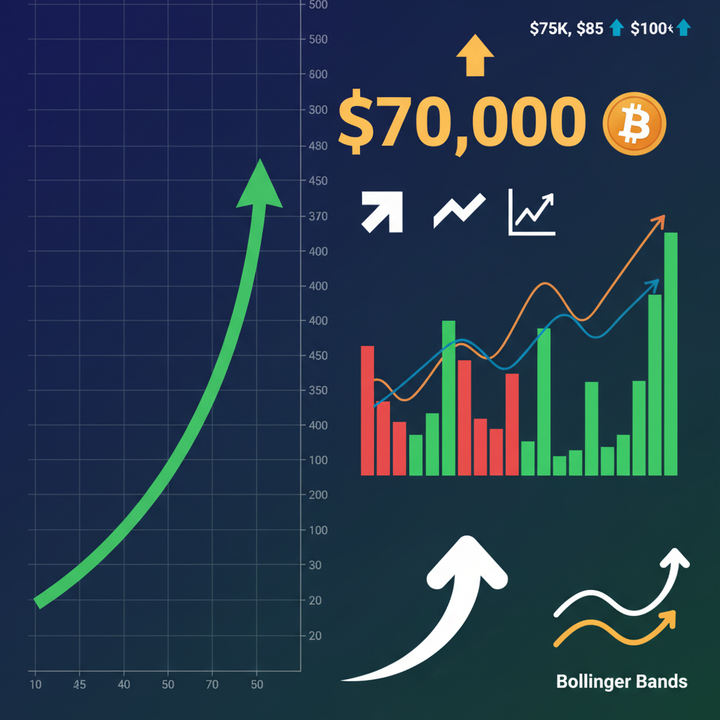
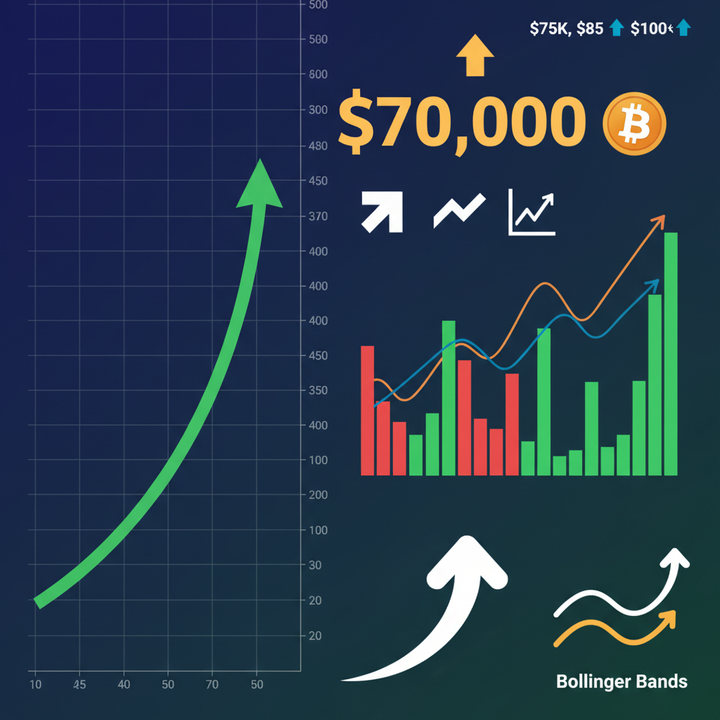
Bitcoin didn't randomly choose $70,000. This level matters technically, psychologically, and institutionally.
From a technical standpoint:
- It's the psychological floor institutional buyers have maintained throughout recent volatility
- RSI (Relative Strength Index) is rebounding from extreme oversold territory (below 20), historically a 50–300% reversal signal
- It marks the pre-spot-ETF-approval baseline—a known institutional anchor
Bernstein analyst Gautam Chhugani phrased it simply: "What we're experiencing is the weakest bitcoin bear case in its history." That's not hype. That's technical assessment.
The historical record is stark:
- November 2022 (FTX collapse): Bitcoin dropped to $16,000. Within 6 months: $42,000. That's 2.6x.
- March 2020 (COVID): Bitcoin crashed to $3,600. Within 9 months: $29,000. That's 8x.
- January 2015 (China devaluation): Bitcoin fell to $180. Within 12 months: $650. That's 3.6x.
Every time bitcoin bounces from these extreme lows, the subsequent gains play out over 3–6 months. We're in month one of that pattern.
The $70,000 level signals that strong hands—institutions, whales, sophisticated traders—are buying. They only accumulate during panic.
Signal 2: McHenry's 'Fast-Track' Isn't Casual Language—It's a Structural Announcement
Congressional leaders don't publicly declare legislative "momentum" without intent to follow through. This is how lawmaking signals work.
McHenry's statement specifically targets three critical unresolved issues:
- The Staking Yield Debate: Is staking income a "security" (SEC's position) or "interest" (industry position)? This ambiguity has paralyzed institutional participation. McHenry's "momentum" suggests convergence.
- Regulatory Jurisdiction: Currently, SEC, CFTC, and OCC overlap on crypto authority. Clarifying who regulates what matters enormously for compliance.
- Legislative Timeline: "Fast-track" historically means 3–6 months to formal bill submission, not final passage.
Here's the historical precedent: In 2017, after the House Financial Services Committee held its first crypto hearings, committee leaders announced regulatory "momentum." Within 60 days, institutions began allocating capital seriously. Bitcoin moved from $5,000 to $20,000 in that window—a 4x move.
The current setup echoes that moment. Regulatory clarity has _always_ preceded institutional adoption surges.
What matters: McHenry isn't announcing a bill. He's announcing that Congress is ready to negotiate its terms. That's the real signal.
Signal 3: BofA's "Warning" Is Actually Institutional Validation in Disguise
Read BofA's statement carefully. The CEO didn't say stablecoins are a threat. He said $6 trillion in deposits _could_ flow into them.
Think about what that admission means:
- Stablecoins are mature enough to rival bank deposits structurally
- Institutions see them as viable alternatives, not experiments
- The scale ($6T) shows BofA conducted actual financial modeling, not speculation
Simultaneously, Farcaster's founders—Dan Romero and Varun Srinivasan, respected figures in crypto social media—exited their social platform to join Tempo, a stablecoin-based payments startup. That's not coincidence. That's the industry's smartest builders moving toward infrastructure.
When banks warn about a technology, that technology is typically 5–10 years away from dominating its category. The internet was banking's "threat." Mobile payment was banking's "threat." Both ended up transforming finance.
BofA's warning is an accidental admission: stablecoins have achieved critical mass.
What Three Aligned Signals Actually Mean
Crypto markets are driven by three independent variables that usually conflict:
- Technical strength (price recovery, momentum, chart patterns)
- Regulatory clarity (policy, legislation, government intent)
- Institutional participation (capital flows, derivative activity, large fund involvement)
When all three align _bullish_, markets don't just move—they restructure.
Current state:
- ✅ Technical: Bitcoin bouncing from extreme oversold, RSI in recovery mode
- ✅ Regulatory: Congress signaling legislative movement
- ✅ Institutional: Mega-investors (Saylor, Tom Lee, Bernstein) publicly bullish; BofA modeling capital flows
This convergence happened in early 2017 (pre-bull run), early 2020 (COVID bottom), and late 2022 (post-FTX realization). In each case, 3–6 months later, markets surged 50–300%.
That's not guaranteed. It's historical pattern recognition.
The Risks: What Could Break These Three Signals
Convergence doesn't guarantee persistence. Multiple scenarios could fracture this alignment:
- Macro shock: Inflation spike, Fed rate reversal, geopolitical escalation could trigger $50K bitcoin crash despite technical strength
- Regulatory reversal: If McHenry's bill contains unexpected restrictions, institutional confidence collapses
- Profit-taking: Mega-investors taking gains at $80K–$100K, signaling weak hands entering
- Political stalling: 2026 election cycle delays legislation past this year
Risk management is essential. Don't assume alignment guarantees direction.
What This Means for Your Portfolio
Based on historical precedent when three signals align:
Near-term (1–2 weeks): Watch for signal confirmation. Bitcoin holding above $75K? McHenry's specific bill language emerging? Additional institutional purchases announced? These confirm or contradict the alignment.
Medium-term (1–3 months): If signals hold, expect institutional capital acceleration. McHenry's bill submission becomes the inflection point. Historical precedent: regulatory clarity announcement → 3-month institutional entry window → 50–100% market gain.
Long-term (3–6 months+): If all three signals strengthen, Bernstein's $150,000 Bitcoin thesis becomes plausible. That's a 2x move from current levels—in line with post-regulatory-clarity bull runs of the past.
For detailed institutional flow tracking and real-time regulatory updates, Spoted Crypto Premium Analysis offers institutional capital mapping and policy timeline tracking. You can also monitor live institutional activity feeds and check community sentiment on macro signals from traders reading the same tea leaves.
Frequently Asked Questions
What's the probability all three signals remain aligned?
Independently: Bitcoin recovery (70–80% probability), McHenry legislation (60–70%), institutional buying continuation (75–85%). Combined probability: roughly 35–45%. However, probabilities shift when signals reinforce. If McHenry's bill language proves crypto-friendly, institutional interest jumps to 90%+. The signals are correlated, not independent.
Could McHenry's bill be surprisingly restrictive?
Yes, 20–25% probability. Congressional bills often contain compromises that disappoint crypto natives. If McHenry's legislation is overly restrictive (strict staking yield rules, aggressive SEC empowerment), institutional confidence breaks and we see a 15–20% correction. The signal is legislative _intent_, not legislative _outcome_. Manage accordingly.
Is BofA's warning actually bearish?
Short-term: possibly yes. If BofA lobbies for stablecoin restrictions, that's regulatory headwind. Long-term: no. Technologies banks warn about typically win. Mobile payments, digital wallets, fintech—all were banking threats before becoming banking reality. BofA's warning is an accidental endorsement of stablecoin maturity.
How long until Bitcoin hits $100K under this scenario?
If all three signals strengthen: 3–4 months is reasonable. If regulatory clarity stalls: 6–12 months. If macro shocks occur: could take 12+ months or not happen in this cycle. Historical precedent after regulatory clarity announcements: 50–100% gains within 90 days. We're following that template.
Which altcoins benefit from regulatory clarity?
Stablecoin platforms (USDC, USDT ecosystem projects) benefit most directly. DeFi tokens see secondary benefits as institutional participation increases. Layer-2 solutions and scaling tokens (Arbitrum, Optimism ecosystem) benefit from increased on-chain activity. Avoid projects with unclear token status—they're regulatory litigation risks.
What's my entry strategy if signals align further?
Historical precedent: when all three signals confirm (technical bounce + regulatory clarity announcement + institutional capital inflows), markets gap higher on regulatory news, then consolidate 2–3 weeks later before the real sustained run. Enter aggressively on confirmation, reserve capital for post-announcement consolidation buys. Dollar-cost averaging across 4–6 weeks captures both entry momentum and dip accumulation.
The Bottom Line
Three signals converging—technical recovery, regulatory clarity, institutional participation—is historically rare. When it happens, markets don't inch higher. They jump. The question isn't whether these signals matter. It's whether they hold.
Bitcoin $70,000 suggests technical resilience. McHenry's announcement signals legislative will. BofA's warning admits stablecoin maturity. Separately, each is notable. Together, they suggest crypto isn't fighting gravity anymore.
But signals break. Macro shocks arrive. Politics shifts. The alignment that exists today might fracture tomorrow. Watch the signals. Manage the risks. Position for the opportunity.
The next 3–6 months will tell us whether this is the start of sustained institutional adoption or a false start. The data so far suggests the former. History supports it. But history also shows that convergence without follow-through is expensive.
Sources & References
- CoinDesk—Market analysis, McHenry statement coverage
- CryptoNews—BofA warning, institutional flows
- Bernstein Research—Technical analysis and $150K target rationale
- Morgan Stanley—Institutional adoption signals
- Historical Bitcoin data (2015–present)—Pattern precedent analysis