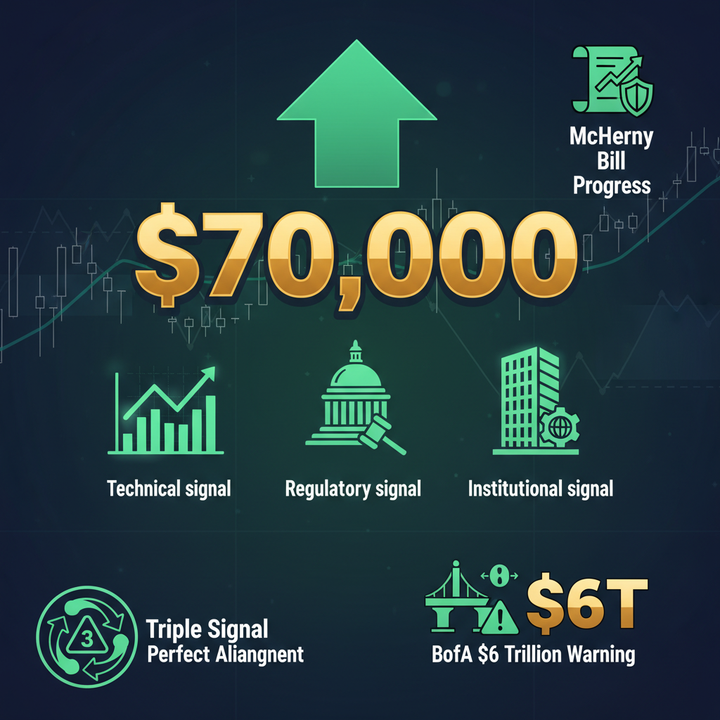
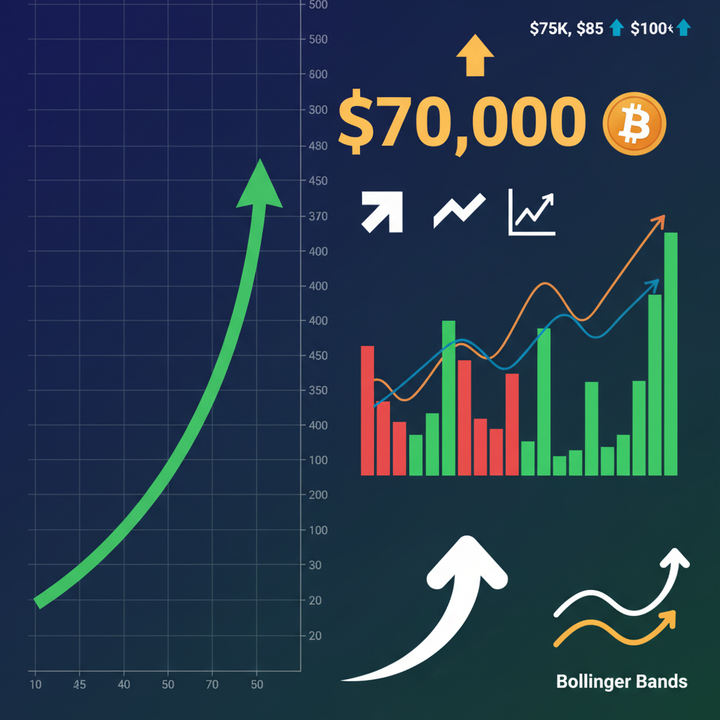
Bitcoin Breaks $70,000 as Bernstein Reiterates $150,000 Year-End Target—Why History May Repeat
Bitcoin surged past $70,000 on February 9 as Bernstein reiterated its year-end target of $150,000. Mining difficulty collapsed 11%, institutional buyers are accumulating, and on-chain signals point to a market bottom. Here's what the data reveals.
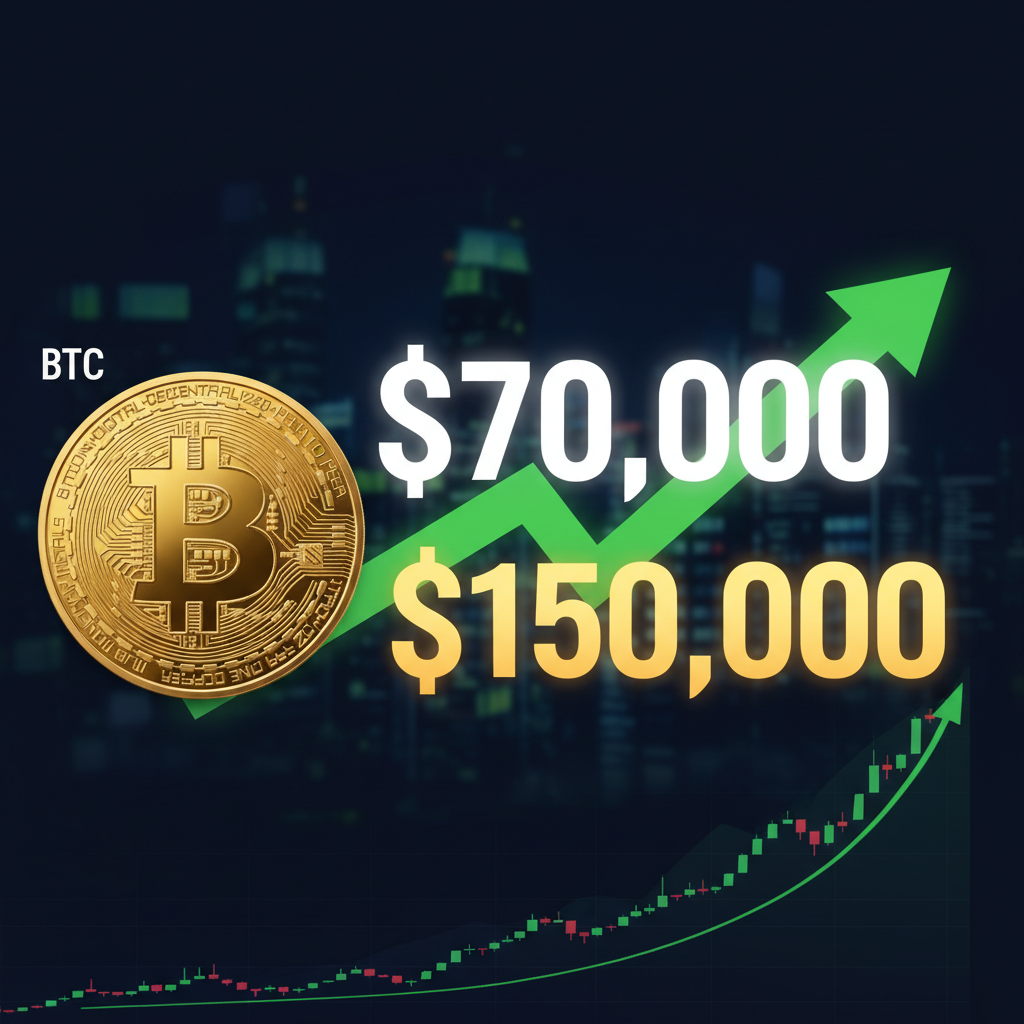
Bitcoin (BTC) has broken through the $70,000 level after a dramatic intraday recovery on February 9, 2026. The leading cryptocurrency briefly dipped to $68,000 before rebounding sharply to $70,800—a sign of strength that extends far beyond a simple technical bounce. Simultaneously, Bernstein's Gautam Chhugani reaffirmed the firm's year-end price target of $150,000, describing the current environment as "the weakest bitcoin bear case in its history." What makes this recovery compelling is not just the price action itself, but the confluence of factors supporting it: an 11% collapse in mining difficulty (the largest drop since 2021), aggressive institutional accumulation, and a macroeconomic backdrop that has shifted dramatically in Bitcoin's favor. By comparing the current bear market to the 2018 and 2022 downturns, we can understand why 2026 may mark a fundamentally different recovery trajectory.
Bitcoin Breaks $70,000: A Structural Recovery, Not Just a Technical Bounce
Bitcoin's path from an October all-time high of $126,000 to this month's lows around $68,000 represents a 45% decline—steep by conventional standards, but historically mild for Bitcoin. The speed of recovery, however, distinguishes this correction from previous bear markets. The rebound was accompanied by broad risk-asset strength: the Nasdaq rose 1%, the S&P 500 climbed 0.5%, gold surged 1.9% to $5,075 per ounce, and silver jumped 7.4% to $82.50. Ethereum (ETH) gained 1.5% to $2,062, while XRP advanced 1.4%. This synchronized rally across asset classes signals improving macro sentiment—not a crypto-isolated bounce.
Bernstein's Gautam Chhugani offered a pithy observation on the psychology underlying Bitcoin's recent weakness: "What we are experiencing is the weakest bitcoin bear case in its history. Nothing blew up, no skeletons will unravel; the media is simply resurrecting its bitcoin obituary." This analysis cuts to the heart of the matter. Unlike the 2018 bear market, which was sparked by ICO excess and regulatory panic, or the 2022 crisis triggered by the FTX collapse and aggressive Fed rate hikes, the current downturn lacks a systemic villain. It is fundamentally a crisis of confidence manufactured by market psychology—what Chhugani metaphorically called "a flat circle" of Bitcoin's recurring boom-bust narrative.
Historically, Bitcoin's price action during bear markets has followed a predictable pattern. The 2018 bear market saw Bitcoin plunge from $19,500 to $3,600—an 82% decline—before recovering over approximately two years to reach $11,000 by late 2019 and eventually $69,000 by late 2021 (a 1,817% gain from the bear market low). The 2022 bear market saw Bitcoin fall from $69,000 to $19,000—a 73% collapse—before recovering to $69,000 again by 2024 (a 263% gain in two years). The current 45% decline is materially shallower than either previous bear market, suggesting recovery could be proportionally faster.
Bernstein's $150,000 Target: Conservative or Aggressive?
A $150,000 price target from $70,000 implies a 114% gain over the remainder of 2026. At first glance, this seems aggressive. But in historical context, it is remarkably conservative. Bitcoin's bear-to-bull cycle rallies have historically delivered 400-600% gains from trough to subsequent bull peak. From the 2018 bottom of $3,600 to the 2021 peak of $69,000, Bitcoin returned 1,817%. From the 2022 bottom of $19,000 to the previous cycle peak of $69,000, the gain was 263%. The $150,000 target represents only one-third to one-quarter of these historical returns—a disciplined and achievable target given Bitcoin's halving cycle dynamics.
Bernstein's reasoning rests on several fundamental pillars. First, the approval of Bitcoin spot ETFs in early 2024 removed the last major institutional friction point. Institutional investors can now purchase Bitcoin through their existing brokerage accounts, bypassing the complexity of exchange accounts, KYC procedures, and self-custody security concerns. Bitcoin spot ETF assets under management have grown to exceed $100 billion and continue climbing, representing a structural shift in institutional capital flow.
Second, the Federal Reserve has reversed course on monetary policy. After hiking rates from near-zero to 5.5% during 2021-2023, the Fed paused hikes in September 2024, began cutting in December 2024, and has continued cuts through early 2026. Current fed funds rates sit around 4.25-4.5%, a reduction of approximately 100-125 basis points from the 2023 peak. In a lower-rate environment, the opportunity cost of holding a non-yielding asset like Bitcoin declines dramatically—a crucial driver of crypto adoption among yield-starved investors.
Third, Bitcoin's halving cycle provides a mechanical supply constraint. The most recent halving occurred in April 2024, reducing block rewards from 6.25 BTC to 3.125 BTC. Historically, Bitcoin's bull markets have peaked 9-12 months after each halving: the 2012 halving saw a peak in December 2013 ($1,000), the 2016 halving led to a December 2017 peak ($19,500), and the 2020 halving produced a November 2021 peak ($69,000). We are currently 22 months into the 2024 halving cycle—squarely in the expansion phase of the expected 18-24 month rally window.
Mining Difficulty Collapses 11%: Why Market Bottoms Create Supply Shock
Bitcoin's mining difficulty fell 11% recently—from 141.6 trillion to 125.86 trillion—marking the largest single-adjustment decline since 2021. Mining difficulty, which adjusts every two weeks to maintain a consistent 10-minute block time, serves as a real-time gauge of network security and active mining capacity. A sharp decline signals that miners have disconnected from the network en masse, a phenomenon that occurs only under extreme economic stress.
Why does this indicator matter? Miners represent the most economically rational actors in Bitcoin's ecosystem. Unlike retail traders driven by emotion, miners conduct daily profitability calculations. If the hashprice (revenue per unit of hashing power) falls below their operational costs, they shut down. Currently, the hashprice has collapsed from a peak of $70 per terahash to just $35—a 50% decline. Winter storms in Texas exacerbated the situation, forcing grid curtailment requests that temporarily reduced mining output by over 60%.
Historically, major mining difficulty collapses have preceded dramatic recoveries. After China's 2021 mining ban triggered a 50% difficulty drop, Bitcoin rallied from $30,000 to $65,000 within two months. During the 2018 bear market's deepest phase, mining capitulation preceded a subsequent 50x return over the following bull cycle. Charles Schwab's Jim Ferraioli noted that "Previous selloffs have usually bottomed near Bitcoin's cost of production. Miners with less efficient equipment often shut down temporarily. We can see this happening in real time by watching mining difficulty—as more miners leave, difficulty falls. Once it starts rising again, that confirms the bottom is in."
The current difficulty collapse signals that weak hands have been forced out. The remaining miners are comparatively efficient and committed. As difficulty begins rising again—as it historically has within weeks of such capitulation—the survivors will enjoy dramatically improved profitability, creating a self-reinforcing cycle of renewed investment and network growth. This is a mechanical process divorced from market sentiment: supply constraint plus renewed demand equals price appreciation.
On-Chain Data: Institutions Are Buying the Dip Aggressively
While retail investors panic-sold during the recent weakness, institutional capital has flowed in steadily. MicroStrategy (MSTR), led by Bitcoin evangelist Michael Saylor, purchased 1,142 BTC at an average price of $78,815—approximately $90 million—near the onset of the recent selloff. This is the continuation of a multi-year strategy: MicroStrategy now holds over $40 billion in Bitcoin, making it the world's largest publicly-traded corporate Bitcoin holder by far.
Tom Lee's Bitmine Immersion took an even more aggressive stance, accumulating 40,613 ETH during the recent dip. The firm now holds 4.3 million ETH—approximately 3.6% of Ethereum's entire circulating supply—worth roughly $8.7 billion. This makes Bitmine Immersion among the largest individual Ethereum holders on the planet.
Crypto-related equities reflected this institutional enthusiasm. Bullish (BLSH) surged 14.2%, Galaxy Digital (GLXY) gained 8.2%, and Circle Financial (CRCL) advanced 5.1%. MicroStrategy stock (MSTR) rose 3%, and Coinbase (COIN) gained 1%. Mining-focused companies with AI pivots saw outsized gains: Morgan Stanley's initiation of positive coverage on TeraWulf (WULF) and Cipher Mining (CIFR) drove both up 14%, while Hut 8 (HUT), IREN, and Bitfarms (BITF) each advanced roughly 7%. This ecosystem-wide strength signals that institutional capital sees not merely a Bitcoin opportunity, but a comprehensive blockchain infrastructure play.
Macro Tailwinds: Rate Cuts, Dollar Weakness, and Regulatory Clarity
The global macroeconomic environment has shifted decisively in Bitcoin's favor. The U.S. dollar index has declined from 104 in mid-2024 to approximately 100 today—a 4% drop. Dollar weakness benefits all hard assets, but especially alternative stores of value like Bitcoin. As the dollar depreciates, emerging-market investors increasingly purchase Bitcoin as a hedge against currency debasement. U.S. inflation has also cooled substantially: CPI fell from 8.2% in September 2022 to 2.5% today, easing the need for immediate Fed support while removing policy headwinds for risk assets.
Critically, the Fed's pivot to rate cuts creates a powerful technical setup for Bitcoin. Lower rates reduce the opportunity cost of holding non-yielding assets. Simultaneously, rate cuts have historically coincided with equity market strength and risk-asset appreciation. Bitcoin, as the highest-beta risk asset in traditional portfolios, benefits disproportionately from this environment.
Regulatory clarity has also improved dramatically. The Trump administration's return to power in 2025 has accelerated a pro-crypto policy shift. The President has publicly stated that "Bitcoin is the American Dream," and discussions around a strategic Bitcoin reserve for the U.S. government—analogous to oil reserves—are now mainstream policy discussions. This represents a historic validation of Bitcoin as a national-level strategic asset.
Europe has formalized crypto regulations through the MiCA (Markets in Crypto-Assets Regulation) framework, establishing clear guardrails that enable traditional finance participation. Japan has liberalized crypto exchange regulations, and Asia broadly is rationalizing digital asset policy. These regulatory improvements remove what we might call the "uncertainty premium"—the discount applied to Bitcoin's valuation due to future regulatory risk. As regulation becomes clarity rather than threat, this premium evaporates, and valuations adjust upward.
The Halving Cycle: Why 2026 Is a Critical Window
Understanding Bitcoin's halving cycle is essential to understanding the $150,000 target. Bitcoin's protocol specifies that mining rewards halve every 210,000 blocks, or roughly every four years. Initial rewards began at 50 BTC per block, halving to 25 BTC in November 2012, then to 12.5 BTC in July 2016, then to 6.25 BTC in May 2020, and most recently to 3.125 BTC in April 2024.
Bitcoin's bull markets have consistently followed a predictable halving-cycle pattern: quiet accumulation for 3-6 months post-halving, followed by a 9-12 month explosive rally. The 2020 halving (May) led to explosive gains beginning in September 2020 (the "bottom") and peaking in November 2021. The 2024 halving (April) has followed this pattern: Q2-Q3 2024 was quiet, Q4 2024 saw initial strength, and 2025-2026 is the anticipated explosive expansion phase. We are currently 22 months into this cycle, placing us in the prime expansion window historically. The 2020-2021 cycle saw Bitcoin gain 350% between month 9 and month 19 post-halving. Similar dynamics should support $150,000 by year-end 2026.
2018 vs. 2022 vs. 2026: Why This Bear Market Is Fundamentally Different
The 2018 bear market (from $19,500 to $3,600) was rooted in structural problems: ICO excess, security failures, and regulatory crackdowns in major jurisdictions like South Korea. Recovery took approximately two years because the underlying issues required market healing.
The 2022 bear market (from $69,000 to $19,000) was triggered by the FTX collapse—a systemic shock that destroyed institutional confidence—combined with aggressive Federal Reserve rate hikes that crushed all risk assets simultaneously. Recovery also took roughly two years as institutions rebuilt trust and the Fed stabilized monetary policy.
The 2026 bear market is categorically different. There is no structural flaw, no collapsed exchange, no systemic bankruptcy, and no policy headwind. Instead, we have pure technical weakness and psychological panic. Bernstein's characterization of this as "the weakest bear case in Bitcoin's history" appears accurate. The macro environment is improving (rate cuts), regulatory environment is improving (government clarity), and institutional catalysts are improving (ETF adoption). This means recovery could be substantially faster than the 2018 and 2022 precedents. Already, we have recovered roughly halfway from the lows in just four months—a pace that would imply full recovery by mid-2026 if sustained.
On-Chain Metrics Confirm Market Bottom: Long-Term Holder Accumulation and Exchange Outflows
Beyond mining difficulty, multiple on-chain metrics validate that we are near or at the market bottom. First, long-term holder accumulation is surging. This metric tracks investors who have held Bitcoin for more than one year and are adding to their positions. High long-term holder accumulation historically signals the earliest phase of bull markets, as patient capital judges current prices as a buying opportunity. These are not panicked liquidators—they are conviction investors.
Second, exchange outflow (the movement of Bitcoin from trading venues to personal wallets) is accelerating. This indicates investors are purchasing Bitcoin and removing it from exchanges for long-term holding, not preparing to sell. Conversely, during bear markets, we see exchange inflow as panicked holders rush to liquidate. The current inflow-to-outflow ratio strongly favors accumulation behavior.
Third, the Realized Price metric (the average acquisition cost of all Bitcoin ever transacted) sits around $44,000. Bitcoin currently trades at $70,000, meaning the average holder is in substantial profit. This is not typical of bear market bottoms, where current price usually trades near or below realized price. The fact that current price is 60% above realized price indicates strong conviction among the holder base—those in profit are not selling.
Institutional Adoption Through Bitcoin Spot ETFs
The approval of Bitcoin spot ETFs in early 2024 represents perhaps the most significant structural development in crypto history. For the first time, institutions can gain Bitcoin exposure through traditional securities accounts—no exchanges, no private keys, no custody complexity. Assets under management in spot Bitcoin ETFs have surpassed $100 billion and are accelerating. This is institutional capital discovering Bitcoin as an investable asset class, not a speculative lottery.
Notably, institutional buyers are treating the current weakness as a buying opportunity. MicroStrategy, Bitmine Immersion, TeraWulf, and Galaxy Digital are all adding positions during the selloff. This is not panic-buying based on FOMO; it is disciplined accumulation at discounted prices by entities with 12-24 month time horizons. When institutions buy weakness on 12-24 month horizons, price targets like Bernstein's $150,000 become entirely plausible.
Key Takeaways for Investors
- Dollar-Cost Averaging Beats Timing: Rather than rushing to deploy all capital at current levels, committing to regular purchases over 6-12 months (e.g., $500-1,000 monthly) lowers average acquisition cost and smooths volatility exposure.
- Track Institutional Moves: Monitor SEC filings for MicroStrategy, Galaxy Digital, and major Bitcoin miners. Their accumulation patterns provide real-time market signals more reliable than retail sentiment.
- Monitor Mining Difficulty: Rising mining difficulty after periods of sharp decline is the most reliable technical indicator of bull market initiation. Blockchain.com and Glassnode provide real-time tracking.
- Respect the Halving Cycle: We are early in the post-2024-halving expansion phase. Historical patterns suggest substantial upside through 2026 year-end and potentially into 2027.
- Watch Macro Data Points: Federal Reserve rate expectations, dollar index trends, and emerging-market currency weakness are leading indicators for Bitcoin demand. Track these weekly.
Frequently Asked Questions
Q: Can Bitcoin really reach $150,000 by year-end 2026?
A: Yes, it is plausible. Bernstein's target implies a 114% gain from current levels. Historical halving cycles have delivered far larger returns in similar timeframes. The 2020 halving was followed by an 800%+ return within 18 months. We are already 22 months into the 2024 halving cycle, so substantial further appreciation is within historical norms. However, the $150,000 target is a year-end estimate; pullbacks below this level post-2026 are entirely possible given normal bull-market cyclicality.
Q: I'm afraid to buy at current prices. What if Bitcoin falls further?
A: Investor risk tolerance varies, so there is no universal answer. Objectively, the current environment lacks structural bear-market catalysts: no systemic failures, no regulatory bans, no macro headwinds (quite the opposite). For those willing to invest, dollar-cost averaging—purchasing fixed dollar amounts on a weekly or monthly schedule—eliminates timing risk and locks in a blended average price superior to lump-sum approaches. Even if Bitcoin falls 10-15% further, a year-long DCA program ensures your average entry is far lower than current levels.
Q: Why is mining difficulty collapse a bullish signal? I thought fewer miners meant less security.
A: Mining difficulty collapse does signal reduced security in the short term. However, it also signals that unprofitable miners have exited, leaving only those with structural cost advantages. This increases security efficiency: fewer but stronger miners secure the network more reliably than many weak miners on the verge of failure. Critically, difficulty rises again within weeks of capitulation events as exiting miners' hardware becomes available to remaining operators, and renewed price appreciation improves profitability. Historically, major difficulty collapses have preceded price rallies of 100-1,000% within months. The last major collapse, caused by China's mining ban in 2021, preceded a Bitcoin rally from $30,000 to $65,000 in just 60 days.
Q: How does the 2026 bear market differ from 2018 and 2022?
A: The 2018 bear market stemmed from ICO excess, regulatory crackdowns, and technical concerns (Mt. Gox, exchange hacks). The 2022 bear market was triggered by the FTX catastrophe and aggressive Fed rate hikes that crashed all risk assets. The 2026 bear market has no structural villain—no collapsed exchange, no regulatory ban, no macro headwind. The macro environment has actually improved: rate cuts are underway, the dollar is weakening, and crypto regulation is clarifying rather than threatening. This means recovery duration should be substantially faster. We have already recovered halfway in four months—a pace suggesting full recovery by mid-2026 if sustained.
Q: Should I buy altcoins or just Bitcoin?
A: Bitcoin leads early bull-market expansion. Altcoins historically lag Bitcoin by 1-3 months. For maximum risk-adjusted returns in early bull phases, Bitcoin dominance is advisable. Once the bull market is well-established (typically 6+ months in), altcoin rotation becomes more favorable. Current market conditions favor Bitcoin concentration. Allocate the bulk of exposure to Bitcoin in this early recovery phase, then diversify into Ethereum, XRP, and other large-cap alts once Bitcoin's primary rally phase matures.
For deeper technical analysis, on-chain metrics tracking, and real-time institutional flow monitoring, explore Spoted Crypto Premium Analysis. Stay ahead of market moves with professional-grade tools and expert research.
Sources
- Bitcoin shakes off early decline, returns to $70,000 as Bernstein reiterates $150,000 outlook, CoinDesk, February 9, 2026
- Bitcoin mining difficulty drops by most since 2021 as miners capitulate, CoinDesk, February 9, 2026
- Blockchain.com - Bitcoin Mining Difficulty Historical Data
- Glassnode - On-Chain Analysis Platform
- U.S. Federal Reserve - Historical Interest Rate Data
- SEC EDGAR - Corporate Bitcoin Holdings Filings