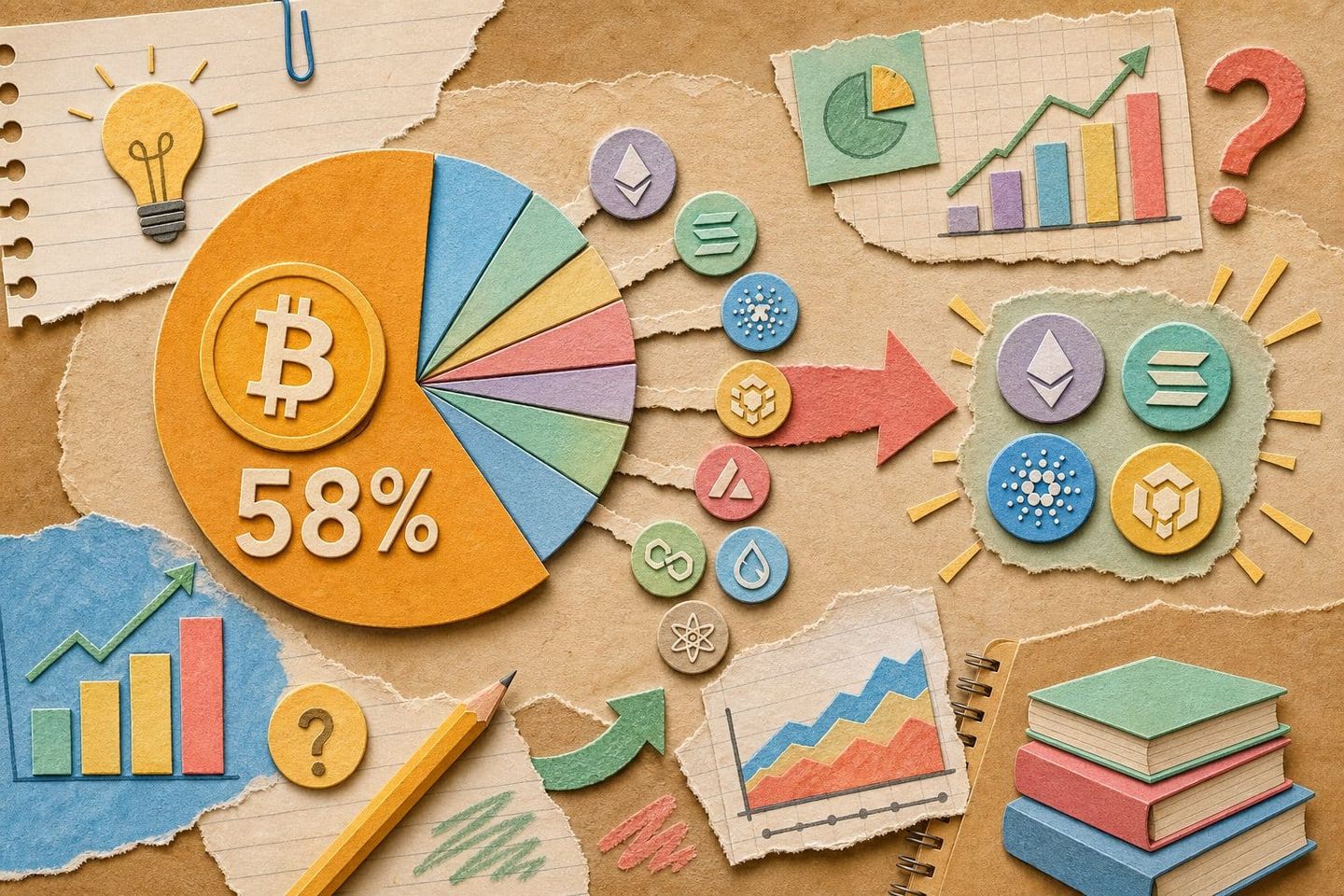
Bitcoin dominance at 58% is not a headline number — it is a filter. It quietly decides which altcoins get a shot at outperforming and which spend the cycle bleeding against BTC.
What 58% BTC Dominance Actually Means for Altcoin Selection
At 58% Bitcoin dominance, the market rewards selection, not breadth: only utility-backed altcoins with verifiable catalysts decouple from BTC's price action, while the rest track it downward. As of mid-2026, Bitcoin dominance sits near 58.23% and total crypto market cap is around $2.14T . That level historically signals a "selective altseason" rather than the indiscriminate 2021-style rotation retail traders remember.
Quick Answer: A broad 2021-style altseason historically requires Bitcoin dominance to fall below roughly 45%. At 58.23% dominance and a $2.14T market cap as of mid-2026, fewer than 1 in 10 altcoins typically outperform BTC — so the "handful of winners" framing is literal, driven by catalysts, not sentiment.
The mechanism is straightforward. Dominance measures Bitcoin's share of total crypto market value, and a broad altseason has historically required that figure to drop below approximately 45% — a threshold the 2025–2026 cycle has not approached. Analysts frame this backdrop not as a market where all altcoins rise together, but one where dominance stays anchored around 58–60% and only high-utility tokens with real catalysts break away . When dominance holds high, the spread between the top decile of altcoins and the bottom 90% widens dramatically — the winners concentrate, and the long tail stagnates.
Institutional flows explain much of the pressure. Spot Bitcoin ETFs have absorbed the majority of new institutional capital, with cumulative Bitcoin ETF inflows exceeding $120B — dwarfing altcoin ETF flows, where even category leader Solana had drawn roughly $1.12B cumulatively by May 2026 . That imbalance leaves a structurally narrower share of fresh capital available to rotate into alts, reinforcing the high-dominance regime rather than eroding it.
The practical takeaway for position sizing is blunt: in a dominance-anchored market, fewer than 1 in 10 altcoins outperform BTC, and analysts note that over 70% of tokens from prior cycles never recovered from their peak drawdowns . That is why every pick discussed in the sections below is treated as conditional — screened for a specific, verifiable catalyst rather than momentum alone. At 58%, the cost of being unselective is not a smaller gain; it is direct underperformance against simply holding Bitcoin.
The October 2025 Liquidation Event: Why Catalyst Discipline Now Defines Returns
The clearest evidence that discipline beats breadth arrived on October 10, 2025, when a single cascade liquidated more than $19 billion in leveraged positions — among the largest wipeouts in crypto history. The trigger was macro, not on-chain: China imposed rare-earth export controls and the U.S. announced an additional 100% tariff on Chinese imports, and an overextended market unwound in hours (video: Brian Jung). For altcoin selection, the lesson is structural — narratives that lack a verifiable catalyst do not survive a forced deleveraging.
The damage was concentrated in altcoins. Top-100 tokens fell 30% to more than 70% within days, a spread that separated assets with real demand from those held up by momentum alone. The setup made the fall worse: open interest had been near all-time highs and positioning was overwhelmingly long, so a single macro shock forced cascading margin calls (video: Brian Jung). That leverage imbalance has since eased but has not fully cleared, which is why any recovery through H2 2026 should still be treated as fragile.
"When positioning gets that one-sided, you're not investing anymore — you're one headline away from a margin call," — Brian Jung, on the October 2025 cascade (source: Brian Jung).
The scar tissue is measurable in behavior. Speculative rotation into low-conviction names has been visibly more cautious heading into the second half of 2026, and that caution is rational: over 70% of tokens from prior cycles never recovered from their peak drawdowns. Every 2026 pick in the sections that follow is therefore conditioned on a sustained Bitcoin recovery — with dominance still near 58.23% and total market cap around $2.14 trillion — not a confirmed bull run.
That history converts into a concrete screening filter you can apply today. Use the October 2025 low as a demand test:
- Recovery ratio: Any altcoin that has recovered less than 50% of its October 2025 drawdown by mid-2026 is signaling weak underlying demand — treat that as a red flag regardless of how strong the narrative sounds.
- Leverage sensitivity: Tokens that fell in the deepest cohort (60%+) and still trade near their lows are momentum-dependent, not catalyst-driven.
- Catalyst proof: Prefer names whose rebound tracks a delivered event — an ETF listing, a protocol upgrade, or revenue — rather than a general market bounce.
Applied consistently, this filter does most of the work of shortlisting. It removes assets that cannot demonstrate demand under stress before their fundamentals are ever debated.
Tier-1 Anchors: ETH, SOL, and XRP Compared
Applying that filter, three assets clear it before any smaller name is even discussed: Ethereum, Solana, and XRP. These are the Tier-1 anchors — the liquidity core recommended for their institutional backing and demonstrated demand rather than momentum . Each carries a distinct, verifiable 2026 catalyst, and the comparison table below is the first decision gate: read it before sizing a single position, because it separates delivered fundamentals from narrative.
Ethereum remains the institutional base layer, hosting roughly 65% of decentralized-finance activity across the market . Its 2026 thesis rests on two delivered mechanics: ETF inflow momentum and fee accrual from its Layer-2 ecosystem. The Pectra upgrade — expanding validator staking limits and adding EIP-7702 account abstraction — sharpens the account-level user experience, but the catalyst investors can actually measure is sustained ETF demand plus L2 settlement revenue, not the upgrade headline itself.
Solana is the fundamentals story. It generated more than $1 billion in application revenue for two consecutive quarters, supports 3,200+ monthly active developers, and runs 1,295 validators across 40 countries — with a Nakamoto coefficient of 20 against Ethereum's 6, a decentralization edge that matters under stress (video: Altcoin Daily) . Its core developers target 1 million transactions per second through the Firedancer and Alpenglow roadmaps, up from roughly 1,200 TPS today .
XRP's catalyst is legal, not technical. Its resolved SEC case removes years of regulatory overhang , and Bloomberg ETF analysts identify XRP as the most-discussed next spot-ETF candidate after Solana — the single largest institutional catalyst still pending for any Tier-1 alt .
"Altcoin ETF summer" is underway, with Solana furthest along and XRP the most-discussed next candidate — Bloomberg ETF analysts (source: UseTheBitcoin, 2026-05).
| Asset | Market standing | Monthly active developers | ETF status | Primary 2026 catalyst |
|---|---|---|---|---|
| Ethereum (ETH) | Largest altcoin; ~65% of DeFi activity | Largest overall base layer dev community | Spot ETF live and accumulating inflows | ETF inflow momentum + L2 fee accrual |
| Solana (SOL) | Top-tier by liquidity; $1B+ app revenue two quarters running | 3,200+ | Spot staking ETF (BSOL) trading since Oct 2025 | Firedancer/Alpenglow scaling toward 1M TPS |
| XRP | Top-tier; SEC case resolved | Payments-focused ecosystem | Filed; most-discussed next approval | Pending spot ETF decision |
The takeaway from the gate is directional. Ethereum offers the deepest institutional footprint, Solana the strongest measurable fundamentals, and XRP the highest-optionality single catalyst still unresolved. All three qualify as core holdings; the differences decide weighting, not inclusion.
AI Infrastructure and DePIN: The Picks-and-Shovels Layer
AI infrastructure and DePIN (decentralized physical infrastructure) tokens are the dominant institutional altcoin narrative of the 2025–2026 cycle, and they earn attention because they sell exposure to AI demand without requiring a bet on which AI model wins . The framing is deliberate: rather than owning an application, you own the compute, data, and coordination layer every application must rent. The most-cited names are Bittensor (TAO), Render (RENDER), Fetch.ai (FET), Akash, and Filecoin — the "picks-and-shovels" of an AI buildout . In a market anchored near 58% Bitcoin dominance, that structural pitch is not enough on its own; the tokens still have to show revenue.
Bittensor (TAO) operates a decentralized marketplace for AI models, capturing value from training demand while spreading it across competing subnets rather than one dominant provider. That distribution reduces single-entity concentration risk, but it also means the honest usage signal lives on-chain: track subnet activity and staking yields as a proxy for whether real workloads — not incentive farming — drive the network. Flat subnet growth alongside a rising price is the pattern to distrust.
Render (RENDER) is the cleanest picks-and-shovels expression of the group: a decentralized GPU compute marketplace that gives direct exposure to AI and rendering workload growth without a view on any specific model. Its evaluation is comparatively legible — compute jobs either grow or they don't — which is why it and TAO sit a tier above the higher-execution-risk names.
Fetch.ai (FET) and Akash occupy opposite ends of the inference pipeline: FET builds autonomous AI agents that act on-chain, while Akash provides decentralized cloud compute those agents can run on. Both are credible, but at current liquidity levels each carries higher execution risk than TAO or RENDER — thinner order books amplify drawdowns, and delivery timelines for agent frameworks are less proven than raw compute rental. Size these as satellite positions, not anchors.
The discipline that separates a real AI-infrastructure position from a narrative trade comes down to two minimum bars:
- On-chain revenue of at least $25M per quarter — a floor that shows the network is being paid for actual work, not subsidizing usage with token emissions.
- Active compute-job or subnet growth — rising, verifiable workload counts quarter over quarter, tied to the token's core service.
A token that clears neither bar is trading on story alone, and in a high-dominance environment story alone is the specific failure mode to avoid — recall that over 70% of tokens from prior cycles never recovered their peak drawdowns . Apply the same catalyst test used for the tier-1 anchors here: verifiable revenue and usage metrics decide the position, and the AI label is what draws you to check, not a reason to buy. Treat this sector as one thematic sleeve of a portfolio, capped and concentrated, rather than a basket to collect broadly.
Solana ETF Inflows and the 6% Staking Yield Structural Advantage
Solana's exchange-traded funds give it a demand channel no other altcoin currently matches at scale, and the yield built into those funds is the reason institutions treat SOL differently from a simple spot bet. The Bitwise Solana Staking ETF (ticker BSOL) began trading on the NYSE on October 28, 2025 as the first U.S. spot Solana ETP , cleared after the SEC accepted generic listing standards for commodity-based trust shares in September 2025 . That regulatory template is what unlocked the broader "altcoin ETF summer" pipeline other tokens are now queued behind.
Quick Answer: Solana's BSOL staking ETF launched October 28, 2025 and pulled cumulative inflows near $1.12B by May 2026, with a 6.01% net staking reward rate baked in — a yield structure Bitcoin ETFs cannot replicate, though SOL's ETF base is still roughly 1% of Bitcoin's $120B+.
The inflow ramp has been steady rather than explosive. Net flows moved from $128M in October 2025 to $420M in November 2025, and cumulative inflows passed roughly $1.12 billion by May 2026, led by Bitwise and VanEck . The differentiator sits inside the fund itself: BSOL showed a net staking reward rate near 6.01% as of May 27, 2026 . A Bitcoin ETF holds a non-yielding asset; a Solana staking ETF pays holders a native protocol reward on top of price exposure, and analysts estimate that yield alone could pull $3–6B into staking-ETF products in their first year .
A second, independent demand driver runs alongside the fund flows. Tokenized-equity issuers — including Tesla, Nvidia, Apple, and S&P 500 products — chose Solana as their settlement layer, and the tokenized-stock network reportedly grew more than 185,000% in 30 days (video: Altcoin Daily) . That matters for selection discipline: ETF flows and real-world-asset settlement are two separate reasons capital arrives, so a stall in one does not zero out the thesis.
| Metric | Solana ETF (BSOL) | Bitcoin ETFs |
|---|---|---|
| First U.S. spot launch | Oct 28, 2025 | Jan 2024 |
| Cumulative inflows (by May 2026) | ~$1.12B | $120B+ |
| Net staking yield | ~6.01% | None |
| Nov 2025 monthly inflow | $420M | — |
Keep the scale honest. Solana's cumulative ETF base is roughly 1% of Bitcoin's $120B+ , which cuts both ways: room to grow, but thinner liquidity and sharper flow sensitivity. Institutional conviction is not uniform either — Bank of America trimmed its altcoin-ETF exposure in Q1 2026 while keeping Bitcoin .
"Solana is furthest along, with XRP the most-discussed next candidate," Bloomberg analysts noted in describing the "altcoin ETF summer 2026" (source: Use The Bitcoin, 2026).
The lesson from Ethereum's post-2024 ETF experience applies directly here: approval opened the door, but sustained inflows and delivered upgrades — not the listing itself — moved the asset . Treat the staking yield as a structural edge that widens the funnel, and track monthly flow direction as the signal that the edge is being used.
Emerging Bets: Kaspa, TON, NEAR, and the RWA Token Layer
Emerging bets are altcoins whose thesis rests on a single verifiable upgrade or usage funnel rather than an established institutional bid — higher variance than Tier-1 anchors, and the sleeve where most 12-month underperformance happens. Kaspa (KAS) activated its Toccata hard fork on June 30, 2026 , adding native smart contracts and converting a pure-payments chain into a programmable one . The catalyst that matters is not the fork itself but the six-month developer adoption rate that follows it — code shipped, not code merged.
TON offers a different, more predictable demand driver. It is wired to Telegram's 950M+ user funnel , and its on-chain activity tends to track mini-app launches rather than broad crypto-cycle sentiment. That decoupling is an advantage — usage can grow while the wider market stalls — but the ceiling is set by Telegram's own monetization policy, a single-point dependency that no amount of on-chain adoption can route around.
NEAR anchors the AI-plus-chain-abstraction thesis: the goal is cross-chain user experience without bridging friction, letting a single account operate across networks . For NEAR, the leading indicator is developer SDK adoption into AI agent frameworks — whether autonomous agents actually settle transactions through it. Absent that pull, chain abstraction stays a whitepaper feature.
The real-world-asset (RWA) layer is the more grounded corner of this sleeve because its tokens capture protocol revenue as tokenized asset balances grow, not just as prices move. Three infrastructure names recur:
- Chainlink (LINK): the leading oracle underpinning most DeFi, and the pricing and settlement backbone that RWA issuance depends on .
- Ondo Finance (ONDO): tokenized U.S. Treasuries, translating yield-bearing government debt into on-chain instruments .
- Ethena (USDe): a synthetic-dollar protocol supplying DeFi yield from the delta-neutral structure behind its dollar .
Sizing discipline is the whole point of this section. Every name here belongs inside the 10–20% high-risk allocation sleeve, not the core . Position sizes should reflect a blunt base rate: most sector-narrative tokens underperform their own story across a 12-month window, and over 70% of tokens from prior cycles never recovered from their peak drawdowns . Treat each of these as a bet on one measurable catalyst — Kaspa's post-fork developer count, TON's mini-app curve, NEAR's SDK integrations, RWA balances on-chain — and cut the position if that specific metric fails to move. The next section turns these sizing instincts into an explicit 60/30/10 framework.
Portfolio Construction: The 60/30/10 Concentration Rule Explained
The 60/30/10 rule is a concentration framework that anchors a portfolio in liquid, institutional-grade assets and rations exposure to higher-risk themes. In practice: a 50–60% base in BTC and ETH, roughly 30% in major liquid alts such as SOL and XRP, and 10–20% in sector themes like AI/DePIN and real-world-asset tokens . When Bitcoin dominance trends upward from its current 58.23% , shift toward the conservative end and shrink the theme sleeve first.
The case for concentration is statistical, not stylistic. Analysts note that 3 to 5 well-researched positions with clear catalysts tend to outperform portfolios holding 15 or more altcoins, and that over 70% of tokens from prior cycles never recovered from their peak drawdowns . In a market anchored near 58–60% dominance, breadth behaves as a drag rather than a hedge: every extra low-conviction token dilutes your winners while adding tokens statistically likely to stay underwater.
"Holding 15+ altcoins in a Bitcoin-dominance-anchored market is a near-certain path to underperformance — 3 to 5 well-researched positions with clear catalysts tend to win," per the 2026 altcoin analysis at Zipmex.
Before any token enters the sleeve, run it through four decision criteria. Each is measurable, and failing two or more should keep the position out:
- ETF status: a live product or an active filing — Solana already trades via the Bitwise BSOL ETP launched Oct. 28, 2025 , with XRP the most-discussed next candidate .
- On-chain revenue: at least $100M annually — Solana generated $1B+ in app revenue for two consecutive quarters, clearing this bar with room to spare .
- Developer trend: a growing year-over-year count — Solana's 3,200+ monthly active developers illustrate the kind of momentum to look for .
- Liquidity depth: top-3 exchange order-book depth above $10M, so you can exit a losing thesis without moving the market against yourself.
Finally, match the framework to your risk tier. Conservative investors should cap sector-theme exposure at 10% and lean the base toward 60% BTC/ETH; moderate investors sit near the middle; aggressive investors can push the theme sleeve to a 20% maximum — never beyond, given the drawdown history above. Institutional behavior underscores the caution: Bank of America trimmed altcoin-ETF exposure in Q1 2026 while keeping Bitcoin . The weights are a starting grid, not a promise; every allocation here stays conditional on a sustained Bitcoin recovery, and none of it is financial advice.
Catalysts and Red Flags to Track Through Q4 2026
Through the back half of 2026, five events will decide whether the selective-altseason thesis holds or breaks. The single highest-impact item is the U.S. market-structure "Clarity Act," which will classify altcoins as either commodities or securities . A commodity ruling for assets like SOL and XRP clears the institutional custody and exchange-listing path; a securities ruling adds regulatory friction and raises the risk of delistings. Treat it as a binary — position size should reflect that you do not know the outcome in advance.
The near-term catalysts to monitor:
- XRP ETF decision: Multiple filings are active, and Bloomberg ETF analysts expect an SEC decision in H2 2026, with XRP the most-discussed next candidate after Solana . Approval would trigger the same institutional inflow mechanism that drove Bitcoin ETF demand — but only if inflows sustain.
- Firedancer / Alpenglow (Solana): A delivered path toward 1M TPS, versus roughly 1,200 TPS today, is a genuine re-rating catalyst . A delayed or scaled-back rollout removes the primary technical differentiation from the Solana case, so watch delivery, not roadmap slides.
- Open-interest red flag: The October 10, 2025 cascade — over $19 billion liquidated — followed a setup of open interest near all-time highs with positioning overwhelmingly long . If those OI conditions repeat, reduce exposure before the event, not after it.
The most important discipline is separating the headline from the flow. ETF approval does not equal a guaranteed price gain: the post-2024 Ethereum ETF launch saw initial net outflows as ETHE conversion selling swamped fresh demand . Solana's own products only confirmed real demand once inflows built — $128M in October 2025, $420M in November, and roughly $1.12 billion cumulative by May 2026 . The confirmation signal to wait for is a sustained weekly inflow trend — four or more consecutive positive weeks — before treating any approval as a durable catalyst rather than a one-day event.
The concrete takeaway: build a short watchlist, not a wishlist. Track the Clarity Act ruling, the XRP ETF decision, Firedancer delivery, aggregate open interest, and weekly ETF flows — and let those five readings, rather than price alone, govern when you add or trim. In a market anchored near 58% Bitcoin dominance, catalyst confirmation is the edge; everything here stays conditional on a sustained Bitcoin recovery, and none of it is financial advice.
Frequently asked questions
Which altcoins are the best picks for the 2026 crypto cycle?
The strongest institutional case sits with the Tier-1 anchors — Ethereum, Solana, and XRP — because each pairs an ETF catalyst with real on-chain revenue rather than narrative alone. Ethereum still hosts roughly 65% of DeFi activity , while Solana generated more than $1B in app revenue for two consecutive quarters and carries a Nakamoto coefficient of 20 . AI and DePIN tokens — Bittensor (TAO) and Render (RENDER) — lead the dominant sector theme . With Bitcoin dominance near 58.23% , a concentrated 3–5 position approach built on verified catalysts tends to outperform broad diversification. None of this is financial advice.
Is BTC dominance at 58% good or bad for altcoin investors?
It is neither simply good nor bad — it functions as a filter. Dominance anchored around 58–60% eliminates weak, catalyst-free altcoins from the opportunity set and concentrates outperformance in a handful of names with verifiable catalysts, which analysts frame as a "selective altseason" rather than a 2021-style broad rally . What matters more than the absolute level is the trend direction: a dominance reading falling toward 50% signals broader capital rotation into altcoins, while a reading rising toward 62%+ argues for staying weighted in Bitcoin and Ethereum. Treat the gauge as a regime indicator, not a buy or sell signal on its own.
What makes the Solana ETF structurally different from the Bitcoin ETF?
The core difference is embedded yield. The Bitwise Solana Staking ETF (BSOL), which began trading on NYSE on Oct. 28, 2025 as the first U.S. spot Solana ETP , carried a net staking reward rate near 6.01% as of May 27, 2026 — a structure Bitcoin ETFs cannot replicate. That yield creates institutional demand beyond price speculation, letting pension funds and endowments hold a return-generating asset. Cumulative Solana ETF inflows reached roughly $1.12B by May 2026, still small against Bitcoin ETF cumulative inflows above $120B , confirming the category is early-stage but growing.
How many altcoins should I hold in 2026?
Evidence from this cycle points to 3–5 concentrated positions, each backed by a clear, verifiable catalyst rather than a story. Holding 15 or more altcoins in a market anchored near 58% Bitcoin dominance is statistically likely to underperform Bitcoin itself, and over 70% of tokens from prior cycles never recovered from their peak drawdowns . Common frameworks reinforce the concentration logic — a 50% BTC/ETH base, 30% majors such as Solana and XRP, and up to 20% split across sector themes like AI, RWA, and DePIN . Breadth dilutes conviction; disciplined selection compounds it.
What is the biggest risk to altcoin positions in 2026?
There is no single biggest risk but three layered ones. First, regulatory: the U.S. market-structure "Clarity Act" will determine whether an altcoin is classified as a commodity or a security, and any token not ruled a commodity faces reclassification risk . Second, macro shock: the Oct. 10, 2025 liquidation cascade erased over $19 billion when open interest sat near all-time highs with positioning overwhelmingly long, sending top-100 altcoins down 30% to 70%+ — monitor aggregate open interest to gauge repeat conditions. Third, catalyst failure: ETF approval alone does not guarantee sustained inflows, as the post-2024 Ethereum ETF experience showed early outflows are possible .
Enjoyed this article? Subscribe to get new stories by email whenever they're published.