Akash Network (AKT) Surges 12% on Upbit as AI Burn Mechanism Defies Extreme Fear
With the Fear & Greed Index at 12 and most altcoins bleeding, Akash Network (AKT) rallied 12.81% on Upbit to rank 4th by volume. Its Q1 2026 AI compute burn mechanism — destroying $0.85 in AKT per $1 spent — is the key catalyst.
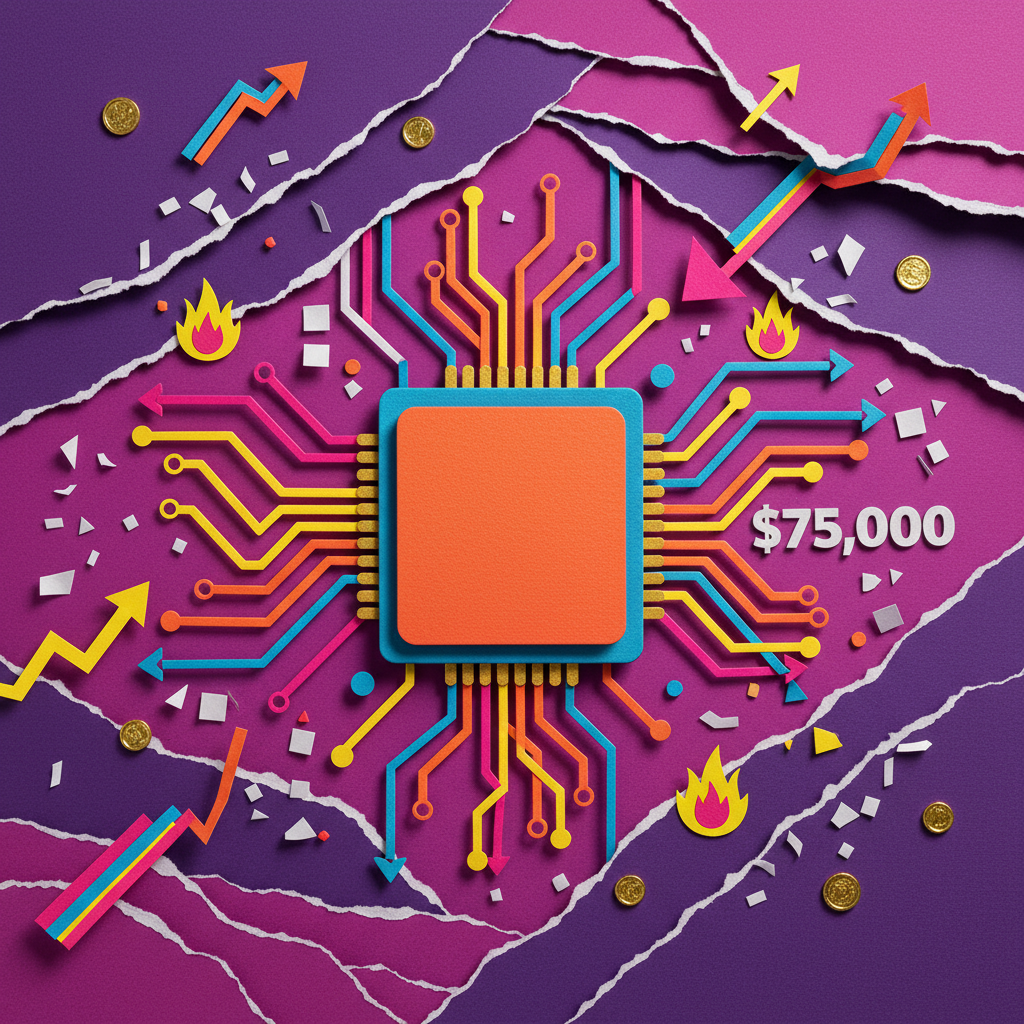
Akash Network (AKT) surged 12.81% on South Korea's Upbit exchange on March 8, 2026, defying a market drowning in extreme fear. With the Fear & Greed Index at just 12 out of 100 — down 6 points from the prior day and part of a 22-day streak below 25 — AKT's breakout is one of the most notable contrarian moves of the quarter.
The catalyst: a newly activated AI compute burn mechanism that permanently destroys AKT tokens every time computing power is purchased on the network. As of March 8, 00:44 KST, BTC trades at $67,825 on Binance (-1.34%) with total crypto market capitalization at $2.40 trillion and BTC dominance at 56.6%. Against this backdrop, AKT's isolated strength demands closer examination.
Why Akash Network Surged 12% in a Fear-Gripped Market
Quick Answer: Akash Network (AKT) jumped 12.81% on Upbit, ranking 4th by volume at ₩32.65 billion. Its Q1 2026 burn mechanism destroys $0.85 in AKT for every $1 spent on AI compute, creating direct deflationary pressure as network usage grows — a rare utility-driven rally in a market gripped by extreme fear.
Akash Network is a decentralized cloud computing marketplace built on blockchain. It connects buyers and sellers of GPU computing power — the same resources needed to train and run AI models — at prices up to 85% cheaper than centralized providers like AWS (CoinCodex).
The key innovation driving AKT's price action is the token burn mechanism introduced in Q1 2026. For every $1 spent on AI computing through the Akash platform, $0.85 worth of AKT tokens are permanently removed from circulation. This creates a direct link between real-world AI demand and token scarcity: as more developers and enterprises use Akash for AI workloads, the circulating supply of AKT shrinks.
On Upbit, AKT traded at ₩590 with a 24-hour range of ₩499 to ₩628 — a 25.8% spread reflecting intense volatility. Trading volume hit ₩32.65 billion, roughly double DOGE's ₩16.4 billion. Among Upbit's top volume coins, only AKT (+12.81%) and SKR (+7.00%) posted gains. The negative kimchi premium on BTC (-0.40%) and ETH (-0.39%) indicates Korean traders were pricing assets below global markets, making AKT's rally against this backdrop even more striking.
| Metric | Value |
|---|---|
| AKT Price (Upbit) | ₩590 |
| 24h Change | +12.81% |
| 24h Volume | ₩32.65B (Upbit Rank #4) |
| 24h High / Low | ₩628 / ₩499 |
| Burn Rate | $0.85 AKT burned per $1 compute spend |
| Kimchi Premium (BTC) | -0.40% |
| Fear & Greed Index | 12/100 (Extreme Fear) |
Crypto Market Snapshot: Extreme Fear Persists
The broader market remains firmly risk-off. As of March 8, 00:44 KST, here are the top movers by volume on Binance:
| # | Coin | Price | 24h Change | Volume(24h) | High | Low |
|---|---|---|---|---|---|---|
| 1 | BTC | $67,825 | -1.34% | $892.4M | $68,795.44 | $67,446.41 |
| 2 | USDC | $1.00 | +0.02% | $617.5M | $1.00 | $1.00 |
| 3 | ETH | $1,978 | -0.30% | $473.3M | $1,996.04 | $1,955.95 |
| 4 | SOL | $84 | -1.47% | $154.0M | $85.90 | $83.42 |
| 5 | XRP | $1.36 | -0.29% | $90.9M | $1.37 | $1.35 |
| 6 | USD1 | $1.00 | +0.01% | $75.8M | $1.00 | $1.00 |
| 7 | DOGE | $0.09 | -0.69% | $50.6M | $0.09 | $0.09 |
| 8 | BNB | $624 | -0.72% | $38.6M | $632.98 | $623.80 |
| 9 | OPN | $0.33 | +3.58% | $35.8M | $0.34 | $0.27 |
| 10 | PAXG | $5,181 | +0.34% | $31.5M | $5,189.69 | $5,139.33 |
On OKX, notable outliers included OKB (+5.49%, $99.90) and PI (+9.82%, $0.229), while most majors mirrored Binance's red. Gold-backed tokens like PAXG ($5,181 on Binance) and XAUT ($5,145 on OKX) continued attracting safe-haven capital.
The Fear & Greed Index at 12 marks 22 consecutive days below 25 — only the third such extended extreme fear stretch since 2018. Earlier this month, the index hit a record low of 5. The CMC Altcoin Season Index sits at 35/100, firmly in "Bitcoin Season" territory, with 38% of altcoins trading near cycle lows.
Derivatives Data: What Futures Markets Reveal
Binance futures data paints a picture of caution beneath the surface. BTC's funding rate sits at 0.0035%, mildly positive, while ETH funding has flipped negative at -0.0009%. XRP's deeply negative funding rate of -0.0089% suggests aggressive short positioning.
| Coin | Funding Rate | Open Interest | Long/Short |
|---|---|---|---|
| BTC | 0.0035% | $5.7B | 65.9% / 34.1% |
| ETH | -0.0009% | $3.9B | 69.6% / 30.4% |
| SOL | 0.0003% | $785.8M | 74.8% / 25.2% |
| XRP | -0.0089% | $361.8M | 72.1% / 27.9% |
| DOGE | -0.0017% | $181.0M | 71.2% / 28.8% |
| BNB | 0.0000% | $317.2M | N/A |
| ADA | -0.0028% | $83.2M | N/A |
| AVAX | -0.0062% | $73.9M | N/A |
| DOT | -0.0118% | $43.7M | N/A |
| LINK | 0.0015% | $75.5M | N/A |
SOL shows the most lopsided positioning at 74.8% long vs. 25.2% short (ratio: 2.97), creating potential for a long squeeze if prices continue sliding. Several altcoin funding rates have turned meaningfully negative — ADA (-0.0028%), AVAX (-0.0062%), DOT (-0.0118%) — indicating shorts are paying longs, a setup that historically precedes either further downside or a sharp short squeeze.
Whales Accumulate While Retail Panics
While retail sentiment craters, on-chain data tells a different story. Whale wallets have accumulated 270,000 BTC over the past 30 days — the largest net purchase in over 13 years. This massive accumulation during extreme fear mirrors patterns seen at previous cycle bottoms.
Bitcoin's 14-day RSI has dropped to the 25.6–27 range. This is only the third time in history that BTC's RSI has fallen below 30: January 2015 at $200 (followed by a 9,900% rally over the next cycle) and December 2018 at $3,500 (followed by a 1,700% rally). Both instances required 3–6 months of consolidation before recovery accelerated.
Matt Hougan, CIO at Bitwise, offered perspective: "The four-year halving cycle is dead. The long-term pro-crypto forces will overwhelm the classic four-year cycle forces. It's more 'sustained steady boom' than super-cycle." (Source)
Rony Szuster, Head of Research at Mercado Bitcoin, echoed this: "Historically, buying during periods of fear has been more effective than buying during euphoria." When the Fear & Greed Index dips below 15, BTC has posted positive 30-day returns in approximately 80% of historical instances.
Institutional flows support the accumulation thesis. Spot Bitcoin ETFs recorded $1.7 billion in inflows since February 24, with weekly net inflows of $917.28 million for the week of March 3–5.
Outlook for AKT and the AI Token Sector
AKT's sustainability hinges on two variables: continued growth in AI compute demand and the resulting burn acceleration. In a bullish scenario, Q2 AI model training demand expands, increasing network utilization and burn rates, while the broader market stabilizes — as extreme fear readings historically resolve upward. External tailwinds include Kazakhstan's planned $350 million digital asset investment starting April–May 2026 and spot BTC ETF inflows maintaining momentum.
The bearish case centers on contagion risk. Despite AKT's strong fundamentals, a deepening market-wide selloff — BTC is already down roughly 45% from its October 2025 all-time high of $125,000, its worst five-month streak since 2018 — could drag AI tokens lower regardless of individual merit. Competition from Solana's Alpenglow upgrade (approved by 98%+ of nodes), which slashes finality from 12.8 seconds to 100–150 milliseconds, could also shift capital toward SOL-based AI infrastructure.
With 22 consecutive days of extreme fear, the market is in historically rare territory. Individual token rallies like AKT's do not guarantee a broader recovery. Avoid excess leverage and consider dollar-cost averaging strategies.
Frequently Asked Questions
How does the Akash Network token burn mechanism work?
Every time AI computing resources are purchased on the Akash marketplace, 85% of the dollar value spent is used to buy and permanently destroy AKT tokens. This creates a deflationary feedback loop: as more AI workloads run on Akash, more tokens exit circulation, increasing scarcity. The mechanism was activated in Q1 2026 and directly ties token value to real network usage rather than speculation.
Should you buy AI tokens during extreme market fear?
Historically, extreme fear readings below 15 on the Fear & Greed Index have preceded positive 30-day BTC returns about 80% of the time. However, individual altcoins carry significantly higher volatility — AKT's 25.8% intraday range on March 8 alone illustrates this risk. Dollar-cost averaging and strict position sizing remain essential for managing downside exposure.
Sources
- Akash Network Price Prediction, CoinCodex
- Fear & Greed Index: Extreme Fear March 2026, SpotedCrypto
- Crypto Market: Whale Accumulation March 2026, SpotedCrypto
- Whales Accumulate 270K BTC in Extreme Fear, SpotedCrypto
- Binance & OKX API data (March 8, 2026, 00:44 KST)
This article is for informational purposes only and does not constitute investment advice. All investment decisions should be made based on your own judgment and risk tolerance.